
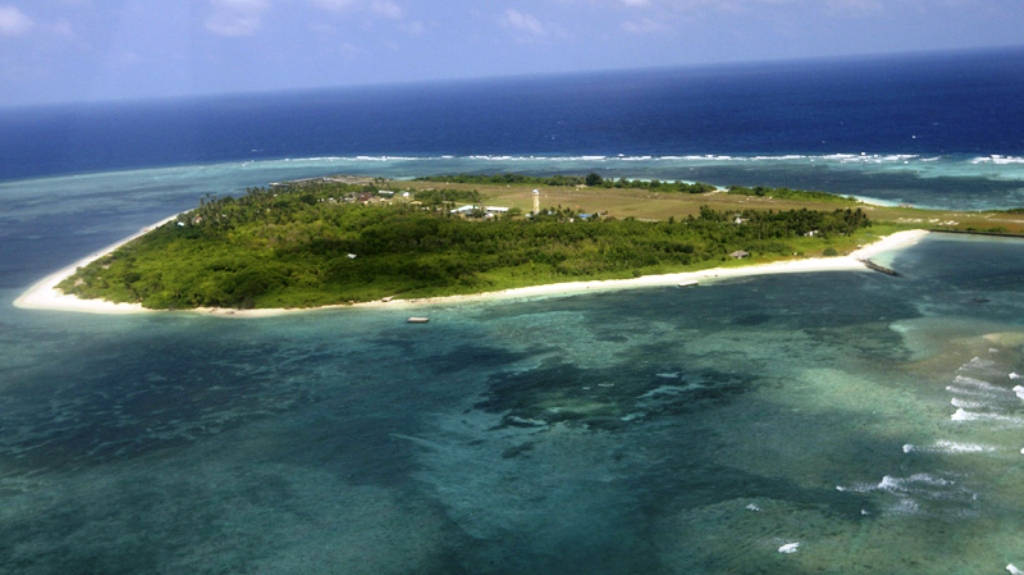
Photographed through the window of a closed aircraft, an aerial view shows Pag-asa Island, part of the disputed Spratly group of islands, in the South China Sea located off the coast of western Philippines on Wednesday July 20, 2011. (AP Photo/Rolex Dela Pena, Pool)
Philippines accuses China of maritime intrusions in December before Christmas
MANILA, Philippines — The Philippines has protested to China over three Chinese vessels that intruded into its waters last month, in the latest flaring of tensions over disputed West Philippines Sea (South China Sea) regions.
The Philippines accused China of intruding into its "maritime jurisdiction" after three Chinese ships were spotted last month in disputed areas in the West Philippines Sea (South China Sea), the Department of Foreign Affairs said on Sunday.
China, the Philippines, Brunei, Malaysia, Vietnam and Taiwan have conflicting claims in the Spratlys, an area believed to contain huge deposits of oil and gas in the South China Sea
A Philippine foreign ministry statement said it had summoned the Chinese embassy's charge d'affaires on Thursday to convey "its serious concerns over recent actions of the People's Republic of China in the West Philippine Sea".
Manila refers to the South China Sea as West Philippine Sea to strengthen its claims on parts of the Spratlys. Philippine troops occupy nine islands and shoals in the Spratlys.
Citing reports from the defense and military establishments, the foreign ministry said two Chinese vessels and a Chinese navy warship were seen around Sabina shoal in the Spratlys on December 11 and 12, respectively.
Sabina shoal is around 124 nautical miles from the western island of Palawan and is within "Philippine sovereignty and maritime jurisdiction".
The Philippine government expressed its "serious concerns" to the Chinese Embassy after the three vessels, including a Chinese navy ship, were sighted near Sabina Shoal in the South China Sea on Dec. 11 and 12, Foreign Secretary Alberto del Rosario said Sunday.
In May 2011, Philippines protested China of intrusions into its territory, citing six instances, including one in March when two Chinese patrol boats tried to ram a survey ship.
The disputed ownership of oil-rich reefs and islands in the West Philippines Sea (South China Sea), through which $5 trillion in trade sails annually, is one of the biggest security threats in Asia.
"These intrusions of the Chinese are clear violations of the 2002 ASEAN-China Declaration on the Conduct of Parties (DOC) in the South China Sea as well as the provision of the United Nations Convention of the Law of the Sea (UNCLOS)," the foreign ministry said.
Regional military commander Lt. Gen. Juancho Sabban said a Philippine navy patrol ship and an air force plane kept watch from a distance until the Chinese vessels left the country's territorial waters.
The three vessels apparently came from the Chinese-occupied Mischief Reef in the disputed Spratly Islands then cruised into Philippine waters on their way back to China as part of a regular shifting of forces, he said.
"We were watching them. They did not drop anchor or unload construction materials and appeared to be just passing through," Sabban told The Associated Press.
The Chinese Embassy in Manila did not immediately respond to a request for comment.
In Beijing, Chinese Assistant Foreign Minister Liu Zhenmin told the official Xinhua News Agency that the situation in the South China Sea "is peaceful and stable." China will always opt for negotiations to peacefully resolve disputes on "some islands ... and the demarcation of parts of the sea," Liu said.
Claimants should set aside the disputes and pursue common development ahead of a solution, Liu said, reiterating that outside "forces" should not meddle in the conflicts. China has repeatedly warned the U.S. not to intervene in the disputes.
Del Rosario said the new Chinese intrusions violated a 2002 accord between China and the Association of Southeast Asian Nations that discourages claimant countries to the South China Sea's disputed Spratly Islands from taking aggressive steps that could ignite tension or confrontations.
China, the Philippines and four other claimants have long been locked in a tense dispute over potentially oil- and gas-rich West Philippines Sea (South China Sea) territories, including the Spratlys.
Many fear the region could be Asia's next flash point for conflict.
The Philippines and Vietnam separately accused Chinese vessels of repeatedly intruding into Spratlys areas under their control and sabotaging oil explorations in their regular territorial waters in the first six months of last year.
China denied the claims and reiterated its sovereignty over most of the South China Sea.
Amid the disputes, the Philippines turned to the United States, a defense-treaty ally, to strengthen its underfunded military, one of Asia's weakest. The Philippine navy relaunched an old U.S. Coast Guard cutter as its biggest warship last month to guard its waters near the Spratlys.
President Benigno Aquino III and other top Philippine officials plan to travel to the United States this year to seek two more ships and a squadron of F-16 jets, according to del Rosario.




